
When entering new markets, many growing brands assume there are only two options:
- Keep shipping everything from one warehouse
- Or, build a second warehouse in the new city
A third option is to use a 3PL warehouse, which will change how goods move to customers in the new city, as well as the logistics costs. This modern option is gaining popularity with independent brands and companies that don’t want to be seen as just a number by the fulfilment centre giants who don’t have any loyalty to independent brands.
This article breaks down what a 3PL actually is, how 3PL warehouse logistics compares to running your own facility, and where the real cost differences show up.
What is a 3PL provider?
A third-party logistics (3PL) provider is a company that manages some or all of another business’s supply chain functions — typically warehousing, order fulfilment, and freight — on a pay-for-use basis rather than as a fixed in-house operation.
It’s worth distinguishing a 3PL from a carrier or a freight forwarder, since the terms get used loosely:
- A carrier moves freight from A to B (think: the courier or trucking company).
- A freight forwarder arranges transport across multiple carriers and legs, often for international shipments.
- A 3PL does both of the above and adds warehousing, inventory management, and pick-and-pack fulfilment — effectively running the physical side of your supply chain for you.
3PL providers are popular with brands that distribute their products in multiple locations.
Rather than shipping parcels from your warehouse in City A that’s far away from the customer in City B, a 3PL provider in City B holds stock of your products and ships the parcel directly to the customer for you – the parcel gets there faster and at a lower cost because it’s nearby.
Where the numbers shift: how break bulk works
The clearest example of how a 3PL changes the cost equation isn’t in the warehouse at all — it’s in how freight moves to get there.
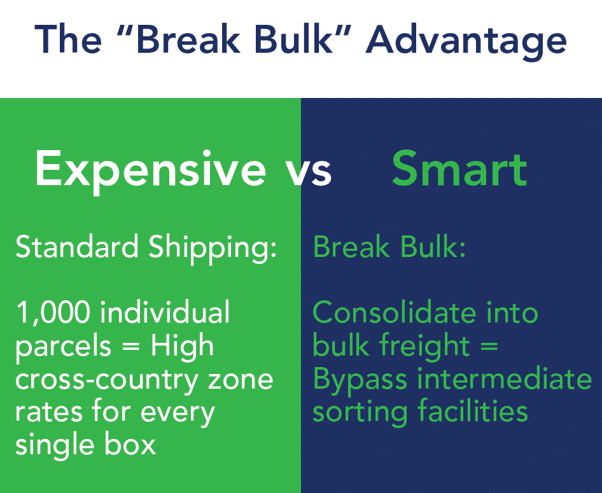
Say a brand is shipping 1,000 individually labelled parcels from its home facility to customers in a single distant region. Each of those parcels goes out at a long-haul zone rate, priced for distance, one box at a time.
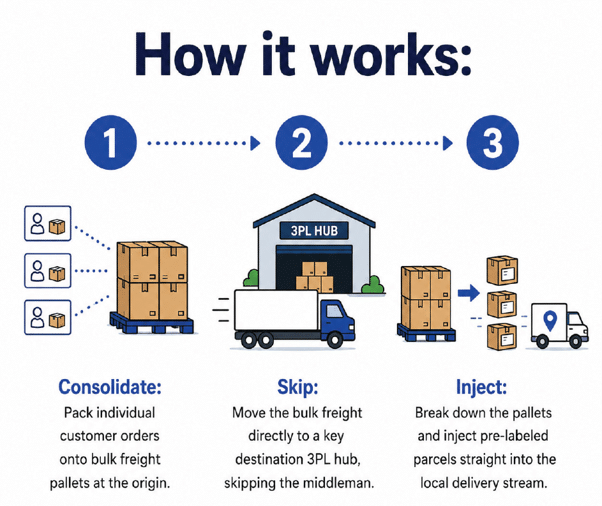
There’s a leaner way to handle this, often called break bulk:
- Consolidate at origin. Instead of handing 1,000 separate parcels to a carrier, they’re combined onto bulk freight pallets.
- Skip the intermediate network. That bulk freight moves directly to a 3PL hub in the destination region — for example, using Brisbane as a gateway into the Australian east coast — bypassing the parcel sorting network that individual shipments would otherwise pass through.
- Go local for the last mile. On arrival, the pallets are broken down and the pre-labelled parcels are injected straight into the local last-mile delivery network.
The financial impact: the long haul is charged at bulk freight rates instead of per-parcel zone rates, and the final delivery leg is charged at cheap local Zone 1 or Zone 2 rates instead of a long-distance rate.
For a brand shipping consistent volume into one region, that’s a materially different freight bill — without opening a second warehouse.
Should you run your own warehouse vs using a 3rd party logistics warehouse?
There isn’t a single right solution — it will depends on projected volumes in the new city, growth pattern, the nature of your business, and whether or not you can find a 3PL warehouse who will provide the right customer experience.
Running your own warehouse in another city — what it actually involves
- Signing a lease, and fitting it with racking, equipment, forklifts and machinery, and technology
- Hiring and managing staff — including through slow periods, when that headcount is still on payroll
- Carrying the full cost of the facility, regardless of whether you ship 50 orders a day or 500
- Learning to handle customs and the culture in a new country
- Full control over packing, branding, and the unboxing experience, since your team handles every order directly
- Allowing time to set up the new warehouse and systems
Using a 3rd party logistics warehouse — what this involves
- Paying for the space and labour you actually use, rather than having your own warehouse with fixed overhead
- Accessing carrier rates a 3PL has negotiated across hundreds of clients — rates an independent brand couldn’t get alone
- Handing over day-to-day control of picking, packing, and handling to someone else’s team
- Expanding into a new region by starting a contract, not setting up a warehouse from scratch (a few weeks vs a few months)
Cost comparison:
Own warehouse vs. 3PL
| Cost factor | Own warehouse | 3PL warehouse |
|---|---|---|
| 1. Upfront capital | High — warehouse lease, racking, equipment, systems | Low to none — no facility to build out |
| 2. Cost structure | Fixed — rent and staff costs continue, regardless of volume | Variable — scales with storage and orders processed |
| 3. Staffing | You hire, train, and manage directly | Handled by the 3PL's existing team |
| 4. Peak season handling | Requires temp hiring or overtime, planned in advance | Absorbed by the 3PL's existing capacity |
| 5. Carrier rates | Can be expensive for small volumes | Access to the 3PL's bulk-negotiated rates |
| 6. Expansion into a new region | New lease, new hires, new setup time | New contract with a member of the 3PL network |
| Long-haul freight to a distant region | You ship every parcel individually at full long-haul zone rate, priced for distance | Parcels consolidate onto bulk freight pallets for the long haul, then move at cheap local Zone 1–2 rates for the last mile (break bulk). |
| 7. Customs and red tape | You need to learn procedures and get the red tape right | The 3PL is familiar with local clearance and does it for you |
| 8. Operational control | Full control over handling, packing, branding | Shared — depends on the provider's flexibility |
| 9. Timing | 3-12 months (or longer) to set up an operational facility | 3 – 16 weeks to sign a contract and deliver a pallet load |
| 10. Best suited to | High, stable, predictable volume in one core region | Variable demand, multi-region shipping, less capital intensive |
This is a general comparison — actual costs depend on your volume, location, and the specific 3PL’s pricing model. It’s worth requesting a quote based on your real order data before deciding either way.
Contact us here if you’d like a quote.
When does building your own warehouse make sense?
Ownership isn’t the best answer for everyone. It tends to make sense when:
- Order volume in one core region is high, stable, and predictable
- The product or handling experience is central to the brand (made-to-order, or highly customised products)
- The business has reached a scale where the fixed cost of ownership is genuinely lower than ongoing per-order 3PL fees
When should you use a 3PL?
A 3PL warehouse tends to be the better fit when:
- Demand is seasonal or unpredictable, and fixed costs would sit idle for parts of the year
- You’re expanding into a new region and don’t want to commit capital before proving demand there
- Time and attention are better spent on product and growth than on managing a warehouse floor
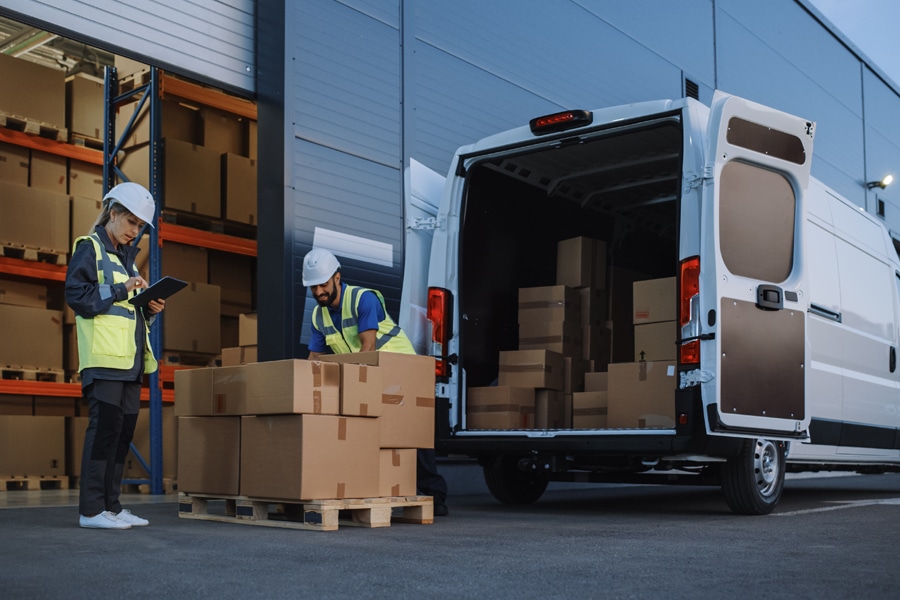
What are 3PL services?
Scope varies significantly between 3PL providers.
Typical 3PL services:
- Warehousing and storage — space for inventory, scaled to what you actually hold
- Pick and pack — order fulfilment as orders come in
- Inventory management — stock visibility and tracking across locations
- Freight forwarding & consolidation — combining shipments from several brands, to access better rates
- Last-mile deliveries — handing parcels to local carriers closer to the end customer
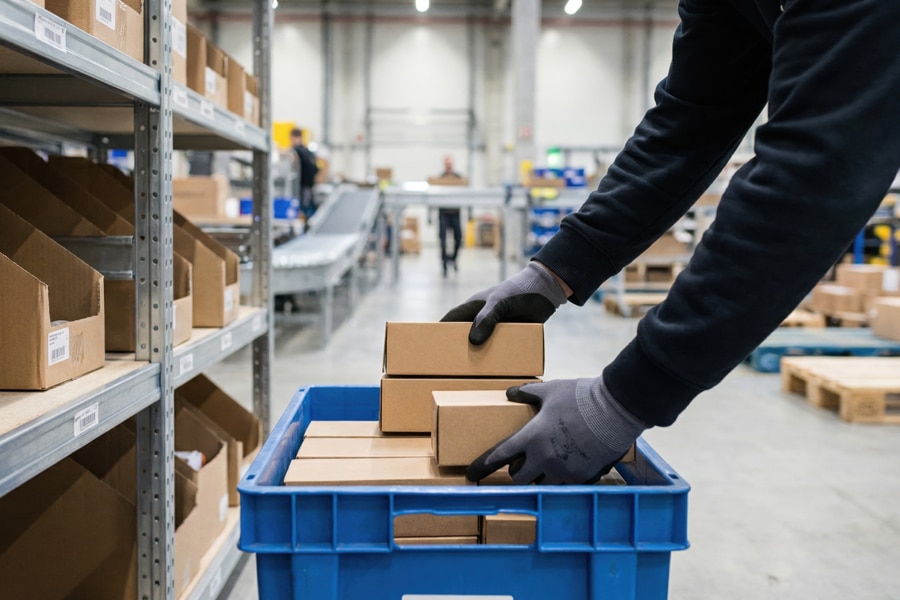
Extra services:
- eCommerce fulfilment – order fulfilment for multiple ecom marketplaces
- Bonded warehousing – allow goods to be stored under customs control while deferring duties and taxes
- Cold chain logistics service – chilled and frozen storage and transportation
- White glove service – for premium customer experiences, such as thank you cards, ribbons, special packaging
- Kitting – assembling several products in a kit or package
- Returns — receiving, processing, and restocking returns

How do you choose the right 3rd party logistics warehouse partner?
If a 3PL looks like the right fit, here are a few things to check:
- Location and network — does their footprint actually match where your customers are?
- Technology and visibility — can you see stock levels and order status in real time, or would you need to call for updates?
- Peak-season capacity — what happens to your orders when their busiest client also has a sale event the same week?
- Pricing transparency — are storage, pick-and-pack, and freight costs itemised, or bundled in a way that’s hard to compare?
We can help you find the right 3PL for your business.
Contact us here to discuss your brand’s needs.
In Summary
Is a 3PL cheaper than running my own warehouse?
It depends on volume and consistency. A 3PL usually wins on flexibility and avoided capital cost; an owned warehouse can be cheaper per order at very high, stable volumes.
How does break bulk freight work?
Parcels are consolidated onto bulk pallets at origin, shipped in bulk to a destination hub, then broken down and injected into the local delivery network for the final leg — replacing multiple long-haul zone-rate shipments with one bulk shipment plus cheap local delivery.