
The 3-letter acronyms, such as FOB or CIF, that are used in the shipping industry can be confusing.
If you’re a business owner, a student, or just somebody who needs to ship parcels, you need to have a basic understanding of what the International Trade Terms mean because they affect your payments and responsibilities.
Even if you’ve studied logistics, you still need to keep up to date with what the Incoterms mean, as they are often updated.
They’re important to know, or you could:
- Be importing products that don’t have the necessary insurance against theft
- Be responsible for the export clearance costs
- Be responsible for paying transport costs you didn’t plan on
We will answer:
- What do International Trade Terms mean?
- Incoterms in 2025 / 2026 – what’s changed?
- What are Incoterms in simple words?
- What do the 11 Incoterms mean?
- Questions people ask us about International Trade Terms
Don’t miss our 2 downloadable guides. We suggest you print out and keep them for reference. The first is a technical guide: Incoterms for Dummies. The second is a simple guide in layman’s terms that’s easy to understand.
What do International Trade / Shipping Terms mean?
The simple explanation: let’s start by explaining WHY they are important.
Shipping things across the world is like a giant game of “Who Moves the Box?”
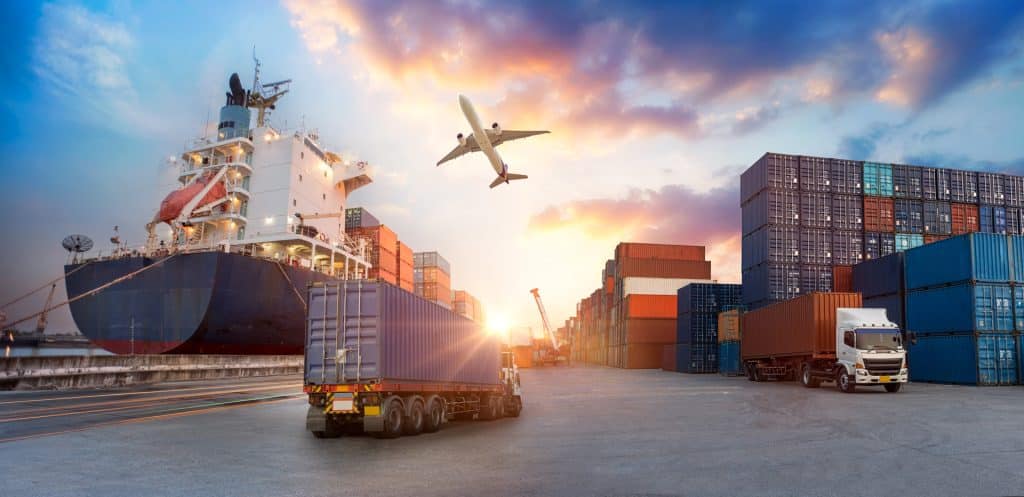
Incoterms are just the official rules for that game. They tell two people — the Seller (the person making the stuff) and the Buyer (the person buying it) — exactly who is responsible for paying the bills and who has to worry if the package gets lost or broken.
What are IncoTerms?
Incoterms is short for International Commercial Terms. They are often referred to by several other names in shipping and logistics, including:
- Trade Terms or International Trade Terms
- Shipping Terms
- Terms of Sale
The term “Incoterms” itself is a registered trademark of the International Chamber of Commerce (ICC).
Definition of Incoterms
According to the official ICC website, the Incoterms rules: “First published by ICC in 1936, Incoterms® rules are a set of eleven three-letter trade terms, reflecting business-to-business practice in contracts for the sale and purchase of goods.”
Incoterms in 2025 / 2026 – what’s changed?
As at March 2026, and according to Wikipedia, they were first issued in 1923. They were amended every ten years or so, with Incoterms 2020 being the latest version.
So, what is the most up-to-date version of the International Trade Terms?
If you’re searching for Incoterms 2023 , 2024 or 2025, they will all be the 2020 version. If you follow the current pattern, the next version of Incoterms is most likely due to be released just before 2030.
Source: Wikipedia – Incoterms, March 2026.
Download International Trade Terms (Incoterms) for Dummies
Here is a technical guide to the international trade terms.
Download our PDF here: IncoTerms for Dummies and print out, so you have it for easy reference. (link)
We recommend first reading the simple explanation of the Incoterms, to gain a basic grasp of the concepts.
NB: Three Things to Remember
1. Risk is not the same as Cost.
Sometimes the Seller pays for the boat (Cost), but if the boat gets stuck in a storm, the Buyer is the one who loses the money (Risk).
2. The “Boat” Rules.
Terms like FAS, FOB, CFR, and CIF are old-school. They are only used for shipping things on water. For everything else (planes, trains, trucks), people use the other terms.
3. DDP is like Amazon.
When you buy a pair of shoes online, and they show up at your door with no extra fees, that’s basically DDP. When you buy something on eBay and have to go to the Post Office to pay extra “Import Fees,” that was likely DAP.
What are Incoterms in simple words? / layman’s terms
Here is a simpler breakdown of the IncoTerms:
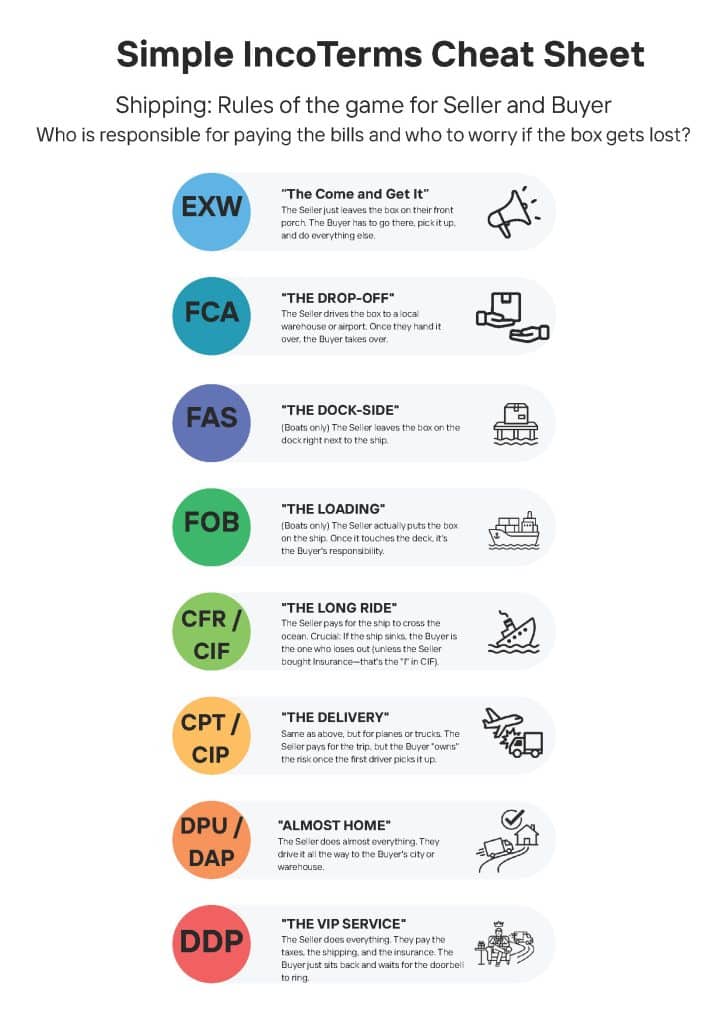
Download the PDF: Simple IncoTerms Cheat Sheet.
Print this cheat sheet out and add to your pinboard.
What do the 11 types of Incoterms mean?
Let’s define each term and give a practical, real-life example.
Any Mode of Transport

1. EXW (Ex Works):
Seller makes goods available at their premises; buyer handles all transport.
Example of Ex Works (EXW)
A buyer in Germany purchases a CNC machine from a seller in China under EXW terms.
The seller makes the machine available for collection at their manufacturing facility in Shanghai.
The buyer arranges for local trucking to the Shanghai port, ocean freight to Hamburg, and final delivery to their factory.

2.FCA (Free Carrier):
Seller delivers goods to a carrier named by the buyer.
Example of Free Carrier (FCA)
A buyer in France purchases custom furniture from a seller in Poland under FCA terms.
The seller delivers the furniture to a transport hub in Warsaw and clears it for export.
The buyer arranges trucking to Paris, assumes risks during transit, and clears the goods through French customs.
3. CPT (Carriage Paid To):
Seller pays for transport to destination, but risk passes when goods are handed to the first carrier.
Example of Carriage Paid To (CPT)
A buyer from a clothing retailer in Australia sources garments from a supplier in India.
The seller handles transport to Sydney and provides shipping documentation.
The buyer assumes risks during the ocean transit and is responsible for import duties and final delivery to their warehouse.
4. CIP (Carriage and Insurance Paid To):
Similar to CPT, but the seller must also provide high-level insurance.
Example of Carrier & Insurance Paid To (CIP)
A buyer from a distributor in South Korea orders vaccines from a Swiss manufacturer.
The seller arranges air freight and insurance to Incheon Airport.
The buyer assumes risks after the goods are handed to the air carrier in Zurich, but benefits from insurance coverage during transit.

5. DAP (Delivered at Place):
Seller bears all risks and costs to bring goods to a named place, excluding unloading.
Example of Delivery At Place (DAP)
A buyer from a food distributor in South Korea imports wheat from an Australian supplier.
The seller organizes shipping to the distributor’s facility in Busan.
The buyer clears customs in South Korea and pays import taxes before unloading the wheat.
6. DPU (Delivered at Place Unloaded):
Seller delivers and unloads goods at the named destination.
Example of Delivery At Place Unloaded (DPU)
A buyer from a supermarket chain in Australia imports packaged food products from a supplier in Thailand.
The seller delivers the goods to the supermarket’s warehouse in Sydney and manages unloading.
The buyer clears the goods through customs and stocks them for retail.

7. DDP (Delivered Duty Paid):
Maximum obligation on the seller, including import clearance, taxes, and delivery to the buyer’s location.
Example of Delivery Duty Paid (DDP)
A buyer from a boutique in the U.S. imports handbags from an Italian manufacturer.
The seller arranges air freight to New York, clears the goods through U.S. customs, and pays import duties.
The buyer takes delivery at their storefront, with no additional paperwork or costs.
Sea and Inland Waterway Transport

8. FAS (Free Alongside Ship):
The Seller delivers goods alongside the buyer’s vessel at the named port.
Example of Free Alongside Ship (FAS)
A buyer in Germany sources coffee beans from a Colombian supplier under FAS terms.
The seller delivers the coffee beans to the Port of Cartagena and positions them alongside the ship.
The buyer oversees loading, export clearance, and shipping to Hamburg.
9. FOB (Free on Board):
The seller is responsible for costs and risks until the goods are loaded onto the vessel.
Example of Free On Board (FOB)
A seller in China loads electronic components onto a ship in Shanghai.
The seller pays for transport to the port and customs clearance.
Once loaded, the buyer takes over the risk and pays for shipping to the final destination.

10. CFR (Cost and Freight):
The Seller pays for transport to the destination port, but risk transfers once goods are on board.
Example of Cost And Freight (CFR)
A seller in a Dutch company sells 50,000 bike tires under the CFR shipping term to a Canadian company. The seller must pack and deliver the goods to be loaded.
The seller arranges transport with a freight forwarder and pays for the shipping until the port of destination in Canada.
As soon as the goods have been loaded onto the ship, the risk transfers to the Canadian company. The buyer takes over the risk and pays for shipping to the final destination.
11. CIF (Cost, Insurance, and Freight):
Similar to CFR, but the seller also covers insurance.
Example of Cost, Insurance & Freight (CIF)
A buyer from a construction company in South Africa buys machinery from an Italian manufacturer.
The seller arranges for shipping and insurance to the Port of Cape Town.
The buyer handles import duties and final delivery after the machinery is loaded in Genoa.
Questions people ask us about International Trade Terms
1. How many Incoterms are there in logistics?
There are 11 Incoterms rules in effect for 2026, as the International Chamber of Commerce (ICC) continues to use the Incoterms 2020 framework.
2. What are the 4 main types of freight?
The four types of freight transport are road, rail, sea (ocean) and air. These modes are selected based on cost, speed, cargo volume, and distance requirements.
- Road Freight: Offers flexible, point-to-point delivery for short to medium distances.
- Rail Freight: An economical and reliable option for moving large quantities of goods over long, domestic distances.
- Sea/Ocean Freight: The most cost-effective solution for international shipping of bulk goods, although it is slower than other freight types.
- Air Freight: The fastest, most secure, and most expensive method, ideal for valuable or time-sensitive shipments.
3. Which is the most used Incoterm?
Free on Board (FOB) is widely considered the most used Incoterm for sea/ocean freight, while Ex Works (EXW), Free Carrier (FCA), and Delivered Duty Paid (DDP) are dominant for air and land, notes DHL.
4. Are Incoterms and FOB the same thing?
No, Incoterms and FOB are not the same thing; FOB (Free on Board) is one of the 11 Incoterms rules set by the International Chamber of Commerce (ICC). Incoterms are the standardized set of international commerce rules, while FOB is a specific, single rule.
5. Which is better, FOB or CIF?
FOB (Free On Board) is usually better for more experienced buyers seeking lower costs and full control over shipping, while CIF (Cost, Insurance, and Freight) is better for beginners needing simplicity and less responsibility.
6. What is the function of the Incoterm three-letter codes (e.g., FOB, CIF, EXW)?
These codes define the responsibilities of buyers and sellers regarding transportation, costs, risk, and insurance.
To find more details about the latest Incoterms, go to the official website of the International Chamber of Commerce (ICC).
If you haven’t yet downloaded the International Trade Terms (Incoterms) for Dummies, download here: IncoTerms for Dummies (link)
As a global logistics team, we work with freight forwarding and logistics all the time. If you’re battling with shipping documents for your company, outsourcing your logistics to our 3PL’s means that we could be handling all the red tape for you and advising you on the best options.
If you’d like to enquire about our shipping services, please contact us.